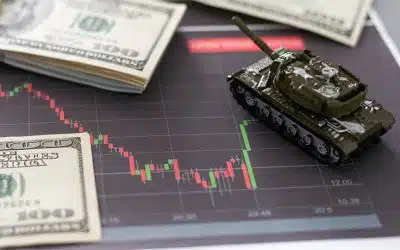
Why international tensions are not weighing on stock markets?

Redacción Mapfre

Donald Trump has upended the chessboard of international politics, yet markets, for now, appear largely unfazed. The military action in Venezuela that ended with Nicolás Maduro jailed in New York—and, above all, the threats to seize control of Greenland, a member of both the European Union and NATO—represent a break with many of the assumptions long taken for granted in the global order. Even so, these developments are unfolding along a very different path from that of equity markets, which remain broadly near record highs and continue the upward trend of the past two years.
The main explanation for this disconnect lies in economic and corporate fundamentals. The risks posed by rising global tensions are undeniably significant, but for the time being macroeconomic indicators remain stable and corporate earnings continue to be very strong, in many cases even exceeding expectations. As long as companies’ ability to sustain those profits and governments’ capacity to service their debt is not called into question, both equities and fixed income are holding at current levels.
“Geopolitical developments have not found a transmission channel into the real economy or into corporate performance,” says Ismael García Puente, deputy director of Investment Strategy at MAPFRE AM. He compares the current situation with other historical episodes in which events of this kind triggered a swift market reaction when they affected oil prices, setting off a domino effect: higher energy costs, weaker business activity, slower growth, and debt crises. For now, that first domino has yet to fall.
Macroeconomic fundamentals hold firm despite the background noise
From a macroeconomic perspective, “despite the headlines and news flow, the underlying backdrop has not changed,” says Ismael García. For 2026, continuity is expected in the economic cycle seen over the past two years, with global growth approaching its potential rate, at around 3%. Along the same lines, Mapfre Economics, Mapfre’s research arm, forecasts growth of 3% this year and notes that inflation, in the absence of shocks that could trigger a turning point, is continuing to moderate.
This dynamic is being supported by fiscal stimulus programs in Europe, the United States, and China, which have helped sustain the strength of the current cycle and are expected to continue providing momentum to the global economy. The risk on this front is that of “overheating,” particularly in the United States, driven by policy measures linked to the upcoming midterm elections.
In addition, and despite the collateral damage associated with such policies, geopolitical conflicts like those currently unfolding could lead to higher public spending on defense, with a resulting increase in GDP—even though, as García notes, this sector has a lower multiplier effect on the broader economy.
Another factor underpinning the relative calm is the role of central banks. Markets believe that, in the event of spikes in volatility, central banks would step in to provide support, thereby limiting the damage.
Weighing scenarios
The apparent calm reflects investors’ belief that the worst-case scenarios will not materialize. In the specific case of Greenland, beyond the threat of annexation, the United States has also floated the possibility of imposing tariffs on the eight countries that have opposed its intentions regarding the island, to which it has sent a limited number of troops. These tariffs would weigh on the growth of the Eurozone.
As Ismael García explains, market consensus expects Donald Trump’s expansionist plans to be another pressure tactic aimed at Europe, designed to secure a greater military presence in Greenland and access to its natural resources, and that the tariffs announced for February will be postponed—as occurred with those announced on Liberation Day in April last year. Analysts are also not anticipating a strong response from Europe.
However, if these forecasts were ultimately to prove wrong and tensions were to escalate into a broader confrontation, stock markets could quickly turn negative. In such circumstances, markets tend to overreact in the initial phase. For this reason, the best course of action in situations like these is to remain calm and consult an expert adviser. In general, rushing to sell investments during sharp market declines is rarely a good idea and can weigh on portfolio returns for a long time.
Turmoil has reached some assets
International tensions contrast with the still-positive trend in equity markets, although markets have not been entirely immune to the challenging environment. For example, since last year’s trade-war announcements, declines have been recorded in U.S. government debt, at times reflecting doubts about its role—and that of the dollar itself—in the global economy. Those losses, however, eased significantly once the situation stabilized. What is clear is that interest rates in the United States are rising, with an increasingly steep yield curve (the additional premium demanded for longer maturities), highlighting uncertainty about the country’s future outlook.
Gold experienced a boom in 2025, with its price surging 65% over the year to more than 4,300 dollars per ounce, a rally that has continued into January. Ismael García attributes this rise to investors turning to gold as a safe haven against the loss of value of the dollar, concerns over fiscal deficits, and central banks’ decisions to diversify their reserves and reduce their reliance on the U.S. currency.